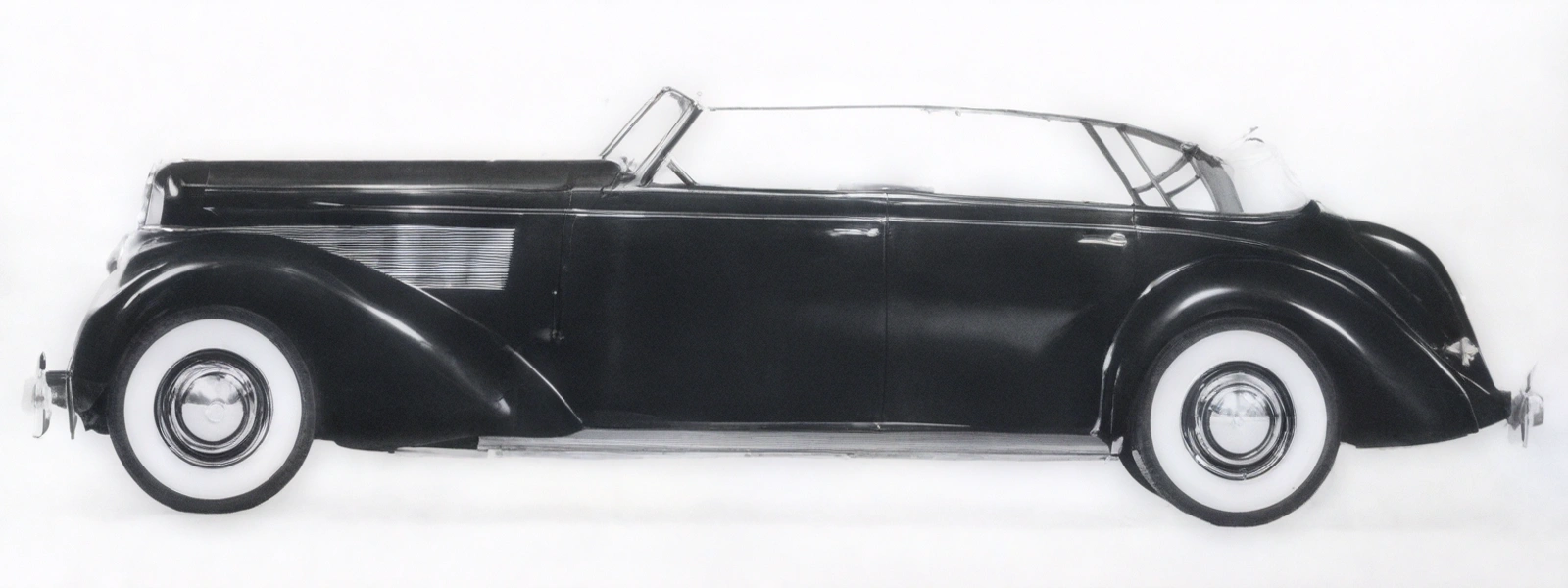

This is a selection of passages from an article that originally appeared on coachbuilt.com. Visit the CoachBuilt site for the full article.
The Willoughby Company was one of America’s larger custom production body builders and the only one who specialized in chauffeur-driven town cars, landaulets and limousines, with virtually no open body styles produced after the mid-twenties. Willoughby’s quality and workmanship was first-rate and although their styling tended to be very conservative.
Today they’re fondly remembered for their catalog custom Lincoln bodies (852 produced) of the twenties and thirties. They also produced bodies for the Springfield Rolls-Royce (370 produced) as well as a small number (49 produced) of enclosed bodies for the Duesenberg Model J. chassis. As with most custom coachbuilders of the classic era, Willoughby produced relatively few one-off custom bodies. Most of their work was for series-built limited production bodies for the major automobile manufacturers of the day. In addition to the Duesenberg, Lincoln, Packard and Rolls-Royce bodies, they did work for Cadillac, Chandler, Cole, Dodge, Franklin, Hudson, Locomobile, Lozier, Marmon, Packard, Pierce-Arrow, Remington, Studebaker and Wills Ste. Claire. The Rockefeller Family, boxer Joe Louis, automaker Horace Dodge, New York mayor Jimmy Walker, and Presidents Calvin Coolidge and Herbert Hoover (Coolidge had two and Hoover had three) were among the many famous and wealthy Americans who owned or enjoyed Willoughby town cars and limousines.
Willoughby’s antecedent was R. M. Bingham & Co. of Rome New York, a builder of carriages, sleighs and wagons who dates back to the Civil War. Bingham was one of the largest carriage builders in Central New York and founded the Bank of Rome in 1875, where he also served as Vice President. R.M. Bingham had a talented engineer named Edward A. Willoughby (1850s-1913) who eventually became responsible for the day-to-day operation of the firm. In 1883 Willoughby married Mary A. Bingham, the bosses’ daughter, who had previously gained notoriety as one of the founders of the Gamma Phi Beta Sorority at Syracuse University
Bingham’s large James Street carriage factory burned to the ground on March 4th, 1897. The Bingham Block loss was well over $100,000 and included a large number of wagons and carriages in various states of assembly. Hundreds of orders remained on the books and Willoughby searched for a suitable manufactory that could complete them. The Utica Chamber of Commerce approached Willoughby alerting him to the fact that the city’s Utica Carriage Co. was in bankruptcy proceedings, and arranged for him to assume management of firm on March 30th under the watchful eye of Charles I. Williams, the receiver.
Utica Carriage Company’s factory was built in 1893 on Dwyer Avenue and Turner Street, a hundred yards west of the city line and adjacent to the New York Central rail lines and Erie Canal. The four-story brick building had a capacity for turning out 800 to 1000 carriages/bodies a year and could easily furnish employment for fifty to one hundred craftsmen, many of whom lived in the German community of Frankfort which was located along the canal just to the east.
In partnership with William H. Owen, Willoughby organized the firm of Willoughby, Owen & Company in 1899 to build a small series of 135 bodies for the Columbia Automobile Company of Hartford, Connecticut. The order, one of the first quantity orders for automobile bodies in the United States, were for Columbia’s new electric car and Willoughby & Owen followed the Columbia with their own electric in 1901. The car was not a success and Owen sold his share in the firm to his partner who reorganized under the name of Willoughby Co. in 1903 to design and build automobile bodies.
Master coachbuilder Ernest M. Galle, was hired to help design and engineer Willoughby’s early automobile bodies. Galle was an old world coachbuilder, who worked for Hoercher & Co., Hamburg, Germany, as chief designer before immigrating to the United States in the 1880s. He quickly found work first with Brewster, and then worked with Willoughby at R.M. Bingham & Co. in Rome. Upon the 1892 death of John D. Gribbon, chief instructor at New York City’s Technical School for Carriage Drafting, Galle filled in until Andrew F. Johnson was hired. Before his arrival at Willoughby he held chief designer and superintendent positions at Henry Killam & Co, Brewster, and J. Curley in Brooklyn.
After his graduation from Hamilton College in 1909, Willoughby’s son Francis D. (Fritz) Willoughby (1887-1955) was first apprenticed to several competitors and upon his return took over the plant, eventually assuming the presidency upon the death of his father in 1913. The next year, Willoughby secured an order from Studebaker for more than 1,000 bodies – its largest order ever and its first million dollar contract. To make the order, the company had to rent outside space and double its workforce from 150 to 300 employees. In 1914, a skilled laborer’s hourly wage ranged from 50 cents to 85 cents an hour, putting Willoughby’s weekly payroll at over $10,000 per week.
Willoughby acquired the services of draftsman Martin Regitko in 1914 and he remained with the firm through its demise in 1938. Originally hired as a supervisor, Regitko eventually took charge of all design and engineering activities in the plant.
While Willoughby built one-off custom bodies for local customers on an occasional basis, the bulk of their business was manufacturing small lots of production bodies for the nation’s auto makers. To obtain those orders, 1/12 scale (1” to the foot) line drawings were made based on dimensions supplied by the chassis manufacturer and features seen on their competition’s products at the previous year’s New York and Paris Salons.
Once approved, a full size body draft was completed and a sample body built, typically in time for the New York Salon or Auto Show. The pricing and final details were decided upon after the body had been shown to the public or manufacturer’s representative.
Willoughby car bodies were made of hard ash reinforced with forged iron. The outside was made of sheet aluminum from the beltline down. The windshield pillars, rear quarters and door frames were made of aluminum castings. The interiors were luxurious with fine upholstering featuring tufted cushions made of exceptionally soft, comfortable padding.
Typical dimensions inside a Willoughby Town Car were somewhat roomier than their competition. Rear seats were typically sixteen inches from the floor to the top of the bottom cushion, and the roof 39-41 inches above it. Upon entering the passenger compartment, owners sunk back into the deep comfortable cushions and relaxed in comfort.
Interiors included deep, thickly padded seats with diamond-tufted pleats, stuffed with foam, horse-hair, or down. Thickly-padded arm-rests could either be removed or folded into the seatback, some rear seats had large down-filled pillows as well.
Most interiors were trimmed with leather piping or coach lace. Fine English broadcloth lined the ceiling, although exposed beam roofs were included on certain formal body styles. Matching arm-slings were mounted just behind the rear door openings and cigarette and vanity cases were built into the rear quarters which sometimes included Lalique flower vases and sconces. Silk curtains covered the wooden window surrounds which were grain-matched to the center dividers included hidden jump-seats, vanities and mini-bars and windows had silk draperies for privacy. Most door panels had leather pockets covered with broadcloth and surrounded by broad lace or wood trim.
From the mid teens through the mid twenties Willoughby built small orders of bodies for Locomobile, Packard, Studebaker, Cole, Marmon and a few others. Typically most orders were for between 25-50 bodies, but occasional orders might run into the hundreds.
Small orders of 5 to 10 bodies were always welcome, however larger orders of 25 to 50 might actually be profitable. Once in a while an order for 100 pieces might be received, but high volume commissions were the exception, not the rule. From the Depression on, the number of bodies ordered by the automakers was greatly reduced, and an individual order of 10 to 25 was now considered large.
Willoughby was one of the few select coachbuilders that were commissioned to build bodies “in the white” (untrimmed and unpainted) for the Rolls-Royce Custom Coach Work program. Others early twenties customers were Cadillac, Franklin, Packard, and Wills St. Claire.
By the mid-1920s, new metal stamping and welding processes developed by Budd’s Joseph Ledwinka caused a revolution in the manufacturing of closed automobile bodies. Stronger, cheaper all-steel bodies could be built in 1 1/0th the time that it took to make an aluminum skinned, Willoughby sedan, effectively pricing them out of the middle price marketplace. Only the well-heeled carriage trade could still afford their hand-built composite-bodied town cars and limousines. When Rolls-Royce of America purchased Brewster in 1925, Willoughby’s involvement with Roll’s Custom Coach Work program ended and their future looked dim. Luckily Edsel Ford came to their rescue with a commission to build a series of closed bodies for Lincoln’s factory custom body program starting with the 1926 model year. The repair and refinishing of existing bodies combined with the Lincoln custom catalog program kept Willoughby (and others) going through the depression. Considering that Central New York’s economy was especially hard hit in the thirties, it’s amazing that Willoughby lasted as long as they did.
Some early 1920s Wills Ste. Claire town cars identified as “by LeBaron.” in their catalogs were actually built by Willoughby, who later ended up designing a few as well. The Willoughby town car design was one of the first to eliminate the belt molding through the rear doors, an idea later copied by others.
Willoughby built a number of town car and limousine bodies for the Marmon 34, and later 74 and 75 Series, some Marmon catalogs identified Willoughby as the builder, others just stated the bodies were “custom built”.
At the 1925 New York Salon (1926 model year) Willoughby showed a Lincoln Enclosed Drive Landaulet, a Springfield Rolls-Royce Coupe, a Wills Ste. Claire Sports Sedan and Town Car.
The conservatively styled Enclosed Drive Landaulet was boxy in appearance and Edsel Ford encouraged Willoughby to come up with a more attractive design for the 1926 Salon (1927 model year). The new design was a straight limousine incorporating a “Brewster Windshield,” which was popular at the time. Brewster developed it as a way to reduce the glare from street lights and the headlights of both oncoming and following cars. Several planes of glass were placed at different angles to the driver’s line of sight with the hope that the light wouldn’t blind him. Brewster hadn’t patented the design and a number of manufacturers and body builders used it during the mid to late 1920s.
Small order were built by Willoughby for Cadillac prior to Fisher’s acquisition of Fleetwood and Willoughby showed a LaSalle Sport Sedan at the 1927 New York Salon (1928 model year).. Small lots of 10-20 formal Limousines and Town Cars with roll-up leather roofs and flush mounted winter hard-tops were built for Pierce Arrow and Packard in 1926 and 1927, but the bulk of Willoughby’s business from then on was for Lincoln.
Their attractive Lincoln Sport Sedan shown at the 1927 New York Salon was eventually sold through Lincoln’s regular catalog and was built by Murray. Many of Lincoln’s standard bodies started life as one-off customs that were later built by Murray or one of their other production body builders. When compared to standard Lincolns, Willoughby-built catalog customs had slightly larger bodies, larger interiors and more luxurious upholstery and appointments.
Duesenberg requested a number of Willoughby limousines and town cars early on. Records indicate 49 Duesenberg chassis were outfitted with Willoughby bodies, though only a handful remain, as many were replaced by trendier phaeton and roadster bodies by their second owners in the early to mid 1930s.
In 1931 Willoughby began making an attractive streamlined two window Sport Sedan for Lincoln and by 1934 the body was included in Lincoln’s “Salon Body Types” catalog.
For the 1932 Lincoln V-12, Willoughby designed an attractive square-backed panel brougham which was the only car they displayed at the final New York Auto Salon. This old-fashioned looking upright limousine was available through 1937 but few were sold, even in its initial offering. Marginally more popular were Willoughby’s attractive fastback coupes limousines and touring sedans of 1937-1938. Very similar to Lincoln’s standard coupes and sedans, they featured much more luxurious interiors and appointments, and a price to match.
In their final few years of operation, Willoughby built less than 50 bodies per year, fully 1/10 of their peak in the mid-twenties.
Upon the closing of the firm in July of 1938, Willoughby’s chief designer, Martin Regitko, went to work as a stylist for Edsel Ford at the Lincoln design facility. Regitko was given the assignment of working up the full size draft and clay mock-up of the 1939 Lincoln Continental prototype, which was designed by Bob Gregorie. It was then transferred to Lincoln Body Engineering which was headed by another old custom builder – Henry Crecelius formerly of Rollston./Rollson. While the prototype was under construction, Regitko showed Edsel Ford a modified plan moving the spare tire inside the trunk, as was the styling trend of the day. Luckily Edsel rejected the idea saying” It’s very nice, but I want it to be strictly continental.”
The firm’s equipment was auctioned off by Samuel T. Freeman & Co., Boston auctioneers on February 3, 1939. Unfortunately, a blizzard swept through Utica the day before the auction and a number of out-of-town bidders failed to attend. Others conspired to keep the prices low, and refused to bid against each other (A common practice that still remains to this day). The only item kept by Willoughby was a large high-wheeled omnibus built by his father in the early days of the firm that featured a glass-enclosed passenger compartment with an overhead luggage rack and the driver’s seat mounted high over the front wheels.
Willoughby’s wife Delia died in 1942 and he later went to work for the Utica Mutual Insurance Co. until a long illness caused his death in 1955. He left three daughters, Mrs. Donald C. Claeys, Mrs. Robert I. Cullen, and Mrs. John D Newlove (all of Utica) and over 20 grandchilden.
As a coachbuilder, Willoughby always enjoyed the highest reputation. He supplied at least five cars to the White House (during the Coolidge and Hoover administrations). At its peak, Willoughby employed 300 craftsmen and, as the Depression wore on, Francis Willoughby refused to compromise his standards and perhaps felt too reluctant to let his people go.
The former Willoughby plant still exists (abandoned) on the Northeast Corner of Pitcher Street and Dwyer Avenue. A fire swept through the top floors sometime after the plant closed and the owners had the top two floors removed. It was later used by the Abelove Linen Service and Myers-Laine Corp.
© 2004 Mark Theobald – Coachbuilt.com
Master coachbuilder Ernest M. Galle
Ernest M. Galle, designer and superintendent with the Willoughby Co., Utica, New York, was born in Dresden, Germany, and learned his trade with his father, who was an artistic coach builder. He was next engaged with Hoercher & Co., Hamburg, Germany, as chief designer, there organizing a drafting class and conducting it four years. After that he came to the United States and entered the employ of Brewster & Co. He was next engaged by R. M. Bingham & Co. as assistant draftsman.
Mr. Galle received the first prize for the best design of brougham draft offered by the C. B. N. A. at the Chicago convention, 1890. He subsequently filled the position of designer and superintendent with Henry Killam & Co., Brewster & Co. and J. Curley, Brooklyn, New York. In 1892 he was appointed instructor in chief to fill the vacancy caused by the death of Prof. John D. Gribbon in the Technical School for Carriage Drafting, and retained this position until the appointment of Andrew F. Johnson, the present incumbent. Mr. Galle’s life has been a busy one, and he is among the most advanced carriage designers.
CoachBuilt Copyright Notice
Copyright Notice
Copyright 2003-2005 Coachbuilt.com, Inc. All rights reserved.
Permission to use, copy and distribute documents and related graphics available within this World Wide Web (“Web”) server (“Server”) is granted, provided that: the above copyright notice and below liability notice appear in all copies and that the copyright notice, this permission notice, and the liability notice appear, use of documents and related graphics available from this Server is for informational and non-commercial purposes only, no documents or related graphics available from this Server are modified in any way, no graphics available from this Server are used, copied or distributed separate from accompanying text.
Permission is, however, granted for use of the Coachbuilt.com, Inc. logos, where the logo represents a link from an administered alternate World Wide Web server to information contained within the relative Database. Applications for trademarks of the Coachbuilt.com, Inc. names and concepts are currently pending. Except where expressly provided above, nothing contained herein shall be construed as conferring by implication, estoppel or otherwise any license or right under any patent, copyright, trademark or other intellectual property right of Coachbuilt.com, Inc. or any other third party. All other product or company names mentioned herein are the trademarks of their respective owners.
The Subject Matter included in this World Wide Web server has been compiled from a variety of sources, and is subject to change without notice. Coachbuilt.com, Inc. reserves the right to add, remove and alter information contained in this site without notice. The documents and related graphics published on this server could include typographical errors or technical inaccuracies.
Links To Third Party Sites
Links to third party Web sites are provided solely as a convenience to you. If you use these links, you will leave this site. Coachbuilt.com, Inc. has not reviewed all of these third party sites and does not control and is not responsible for any of these sites or their content. Coachbuilt.com, Inc. does not endorse or make any representations about them, or any information, software or other products or materials found there, or any results that may be obtained from using them. In addition we make no representation regarding the content or accessibility to content that may or may not be suitable for viewing by minors or other persons. Please contact the individual webmaster regarding their content. If you decide to access any of the third party sites linked to this Site, you do this entirely at your own risk.
Notice Of Liability
Coachbuilt.com, Inc. makes no representations about the suitability of the information contained in the documents and related graphics published on this Server for any purpose. All such documents and graphics are provided ‘as is’ without warranty of any kind. Coachbuilt.com, Inc. hereby disclaims all warranties and conditions with regard to this information, including all implied warranties and conditions of merchantibility, fitness for a particular purpose and non-infringement.
Coachbuilt.com, Inc. applies this Liability Notice to all the information linked to from this site. While we endeavour to maintain the good quality and high tone of the Hyperlinks to other Web servers, Coachbuilt.com, Inc. is expressly not responsible and does not endorse in any way the content, bearing, intent, opinion or other responsibility for any information or content held on alternative World Wide Web servers linked to.
In no event shall Coachbuilt.com, Inc. be liable for any special, incidental or consequential damages or any damages whatsoever, including but not limited to, death, personal injury, damage, loss of use, loss of data, loss of revenues, loss of profit, or loss of prospective economic advantage, whether in an action of contract, negligence or other tortious action, arising out of the use or misuse of this Server or information, Server performance, documents or software herein, even if Coachbuilt.com, Inc. has been advised of the possibility of such damages, or for any claim by another party.
Insofar as Coachbuilt.com, Inc. design and web services are concerned, Coachbuilt.com, Inc. reserves the right to refuse to present information on the web that is destructive, offensive, abusive, obscene or of a menacing character. Coachbuilt.com, Inc. shall also not be liable for the presentation of information that is a violation or infringement of the rights of any person, firm or company (including but not limited to intellectual property rights).
Comments are closed